WallpaperSense

Three Minutes to Calm: How to Choose a Lunch-Break Wallpaper That Feels Like Stepping Into a Chinese Autumn Orchard

You’ve got 20 minutes. Your eyes are tired. Your brain feels like static. Here’s how to choose a lunch-break wallpaper that truly resets you — in three intentional, research-informed steps — starting with the quiet abundance of Chinese-style gongbi fruit trees.

·5 min read

You open your lunch container, take a breath—and then your eyes land on a chaotic, cluttered desktop background that screams 'unfinished tasks.' That tiny visual jolt? It steals your reset before it even begins.

Your lunch break isn’t just about food. It’s your brain’s only scheduled pause—a chance to soften your gaze, slow your pulse, and step out of task-mode—even for three minutes. And the very first thing you see when you look up from your sandwich? Your wallpaper. Not a notification. Not an email preview. Just that quiet, steady image behind your icons. It either deepens your calm—or quietly undermines it.

Here’s how to choose one that helps, not hinders—using real visual science, centuries-old Eastern art principles, and zero extra apps.

Step 1: Anchor Your Eyes With Gentle Visual Rhythm (Not Distraction)

Your brain needs rhythm—not randomness—to disengage from work mode. Think of it like stepping off a treadmill: you don’t stop cold—you ease into a walk. Your visual system works the same way. A wallpaper with gentle repetition—like layered branches arching in soft symmetry, or clusters of fruit spaced with quiet intention—gives your eyes a natural path to follow, not a puzzle to solve.

That’s why busy photos, abstract gradients with sharp transitions, or overly symmetrical stock images often backfire. They force micro-decisions: Where do I look first? What’s that shape? Why is that corner so bright?

Instead, look for:

  • Layered depth without clutter: foreground fruit, midground branches, soft background mist—all distinct but softly connected
  • Organic repetition: repeating leaf shapes, staggered fruit clusters, or rhythmic branch curves—not identical copies, but harmonious echoes
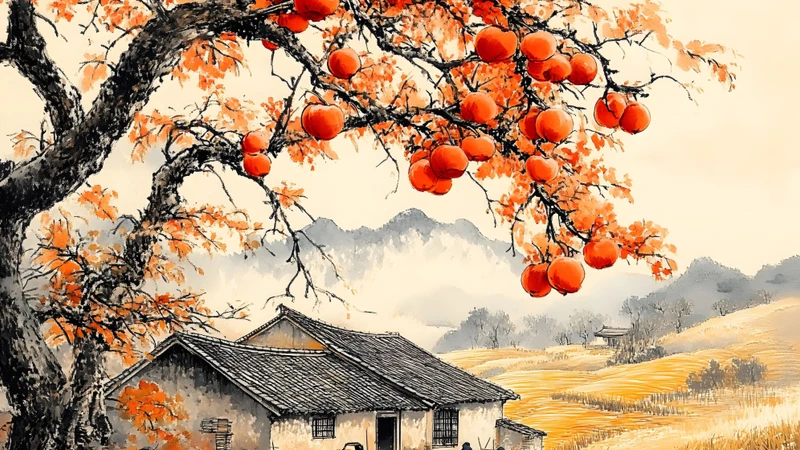
  • A clear, calm focal point: one ripe persimmon glowing gently, not ten competing highlights

Try this: open browse wallpapers and filter for ‘serene’ or ‘natural’. Scroll slowly. Pause when your eyes linger, not scan. That’s rhythm working.

Step 2: Choose Warm, Low-Contrast Colors That Invite Rest — Not Alertness

Color isn’t just mood—it’s physiology. Bright, saturated reds spike cortisol. Electric blues trigger alertness pathways (great for sunrise alarms, terrible for lunchtime stillness). Your lunch-break wallpaper should whisper, not shout.

Warm, low-contrast palettes—like those found in traditional Chinese gongbi painting—support parasympathetic activation: the nervous system’s ‘rest-and-digest’ signal. Think amber persimmons glowing against soft gray bark, dusty pomegranate pinks nestled in misty sage greens, or loquat golds fading into warm beige sky.

These tones feel grounded—not flat. They hold light without glare, and they age gracefully on screen, even after hours of use.

Avoid:

  • High-saturation primaries: neon oranges, traffic-cone reds, or electric teals
  • Cold, stark contrasts: black text on pure white, or sharp cyan-on-gray combos
  • Overly cool palettes: icy blues and grays dominate winter scenes—but they can feel isolating, not restful, at noon

Try this: open your current wallpaper in Preview or Photos, then desaturate it by 30% and warm the tone slightly (+5–10 in color temp). Does it feel softer? More breathable? That’s your cue.

Step 3: Prioritize ‘Quiet Detail’ Over Complexity — Gongbi Art Shows You How

Too much detail overwhelms. Too little feels sterile. The sweet spot? What artists call quiet detail: fine linework that invites closer looking—but restrained color and generous negative space that keep your mind from racing.

That’s the genius of gongbi painting—the meticulous, brushstroke-by-brushstroke tradition behind the Chinese-Style Fruit Tree Gongbi Paintings 4K Wallpaper Pack. Each piece features hundreds of precise strokes defining a single leaf vein or fruit texture—but never at the expense of air, stillness, or breathing room.

Your eyes get just enough to engage—Is that a ladybug on the stem? How many seeds peek from that split pomegranate?—but never so much that they fatigue. It’s visual nourishment, not visual noise.

Look for:

  • Fine linework with soft edges: crisp enough to admire, blurred enough to relax into
  • Textural subtlety: the matte sheen of ripe fruit skin, not glossy Photoshop shine
  • Generous ambient space: mist, soft sky, or blurred foliage that lets your gaze drift, not lock on

Try this: zoom in on a gongbi wallpaper at 150%. Notice how detail lives within calm—not against it. Then compare it to a hyperrealistic photo. Which one lets your shoulders drop first?

Bonus: Why This Works for Remote Workers and Office Dwellers

A single glance at your screen becomes a micro-pause—no app needed, no timer required. That’s the power of intentionality: when your wallpaper is chosen for rest, not just aesthetics, every return to your desk carries quiet continuity.

And gongbi’s harmony translates beautifully across devices. On a wide desktop, the layered orchard composition fills space without crowding. On a laptop, the central fruit cluster stays centered and legible. Even on your phone lock screen, a cropped detail—like a single persimmon glowing against frost-laced branch—delivers the same grounded warmth.

That means whether you’re eating at your kitchen table, a co-working lounge, or a quiet corner of the office, your visual reset travels with you. No headphones required. No meditation app open. Just you, your lunch, and a screen that finally holds space for you—not the other way around.

You don’t need more time. You need better pauses.

The right wallpaper doesn’t fill your screen—it clears your head. It doesn’t distract you from work; it helps you return to it renewed. And when that pause looks like sunlight filtering through persimmon leaves, or mist rising off a quiet orchard at golden hour, it stops feeling like a break—and starts feeling like belonging.

Explore the full collection of hand-selected, rest-supporting visuals at browse wallpapers, or dive straight into the serene abundance of the Chinese-Style Fruit Tree Gongbi Paintings 4K Wallpaper Pack.