WallpaperSense

Your Screen Is a Stress Trigger — Here’s How Anime Landscape Wallpapers Quiet Your Nervous System in Under 60 Seconds

Staring at your screen all day? Discover how carefully chosen nature wallpapers — especially soft-focus anime landscapes — reduce mental fatigue, ease eye strain, and gently reset your nervous system. No apps, no timers — just one intentional swap.

·8 min read

You’ve just closed your third back-to-back Zoom call. Your shoulders are tight, your eyes feel gritty, and your desktop background — that sharp, high-contrast city skyline — suddenly feels like another demand on your attention.

Here’s what most people get wrong: your wallpaper isn’t neutral. It’s not just decoration. It’s the first visual input your brain processes every time you glance up from your document, every time you switch tabs, every time your nervous system pauses to reset — which it does, constantly, dozens of times per hour. Think of it like ambient sound in a café: you don’t notice the hum until it stops — or changes. But unlike sound, your screen’s visual field never fades into the background. It’s always on, always active, always asking something of you.

That city skyline? Its jagged silhouettes, saturated neon signs, and stark black shadows aren’t just bold — they’re biologically loud. Your visual cortex reads them as complexity to decode, your amygdala registers them as mild environmental tension, and your autonomic nervous system responds — subtly, but measurably — with increased muscle tone, shallower breathing, and a tiny uptick in cortisol. You don’t feel it as panic. You feel it as fatigue, irritability, or that vague sense of being “wired but tired.”

Why Your Default Wallpaper Is Secretly Making You Tense

Your default wallpaper — whether it’s a stock photo of mountains, a branded corporate image, or even a favorite band poster — was likely chosen for its aesthetic appeal, not its physiological impact. And that’s the problem. Visual design for beauty ≠ visual design for calm.

Think of your nervous system like a thermostat set to maintain equilibrium. Every visual stimulus nudges that dial — some up (arousal), some down (soothing). High-contrast edges, rapid color shifts (like red-to-black gradients), busy textures (brick walls, pixelated crowds), or emotionally charged subjects (dramatic storms, intense portraits) all register as information density. Your brain treats density like workload — even when you’re not consciously looking at it.

It’s similar to how fluorescent lighting makes a room feel tense, even if you’re not staring at the ceiling. Your peripheral vision picks up flicker and glare, and your body reacts before your mind catches up. A cluttered or emotionally ‘loud’ wallpaper works the same way: it keeps your visual processing system on low-grade alert. Over an eight-hour workday, those micro-stresses compound — like background app notifications you never silenced.

The irony? Many default nature wallpapers also trigger this response. A hyper-realistic rainforest with tangled vines, dappled light chaos, and competing greens doesn’t signal safety — it signals foraging, vigilance, navigation. Your brain evolved to read dense foliage as terrain to navigate — not rest upon.

What Makes a Nature Wallpaper Actually Calming (Not Just Pretty)

A calming nature wallpaper isn’t about realism. It’s about resonance — how closely its visual language mirrors the cues your nervous system has used for millennia to recognize safety, stillness, and restoration.

Three traits separate truly soothing nature wallpapers from merely pleasant ones:

  • Soft edges: Hard lines (building corners, sharp mountain peaks, crisp text overlays) activate your brain’s edge-detection circuitry — the same system that scans for predators or obstacles. Soft-focus, gently blurred horizons, and diffused light halos tell your visual cortex, “Nothing here requires urgent attention.”
  • Harmonious color rhythm: This means colors that flow like breath — not contrast like alarms. Think ocean blue melting into misty gray, warm beige fading into soft sage, or peach light dissolving into lavender dusk. These aren’t random palettes; they echo natural light transitions your circadian system recognizes as restful. Clashing hues (electric green next to hot pink) or jarring saturation jumps create visual friction — like hearing two instruments slightly out of tune.
  • Gentle spatial depth: True calm comes from space you can breathe into, not space you must navigate. A scene with layered but uncluttered planes — distant hills, mid-ground trees, foreground grass — creates a sense of grounded openness. It’s similar to standing at the edge of a quiet lake: your gaze settles softly across distances without needing to focus sharply anywhere. In contrast, flat or overly compressed scenes (a single tree dead-center, no horizon line) feel visually claustrophobic — like staring at a wall.

Here’s what most people get wrong: dramatic nature shots — crashing waves, thunderstorms over cliffs, fiery sunsets — are emotionally stirring, yes. But they’re physiologically activating. They spike adrenaline, not oxytocin. For stress relief, you want the visual equivalent of a long exhale — not a gasp.

That’s why anime-style landscapes often outperform photorealistic ones for daily calm. Their intentional softness, deliberate color harmony, and dreamlike depth aren’t stylistic choices — they’re neurological shortcuts. Studio Ghibli didn’t invent gentle meadows because they looked nice; they painted them because they felt like relief.

How to Test Any Wallpaper in 30 Seconds — Before You Even Set It

You don’t need a lab or a heart-rate monitor. You can assess a wallpaper’s calming power in under half a minute — using only your blink reflex, your breath, and your peripheral vision.

Start with the blink-and-breathe test: Open the image full-screen. Close your eyes. Take one slow, full breath in through your nose — count to four — and out through your mouth — count to six. Now open your eyes and don’t look at anything specific. Let your gaze go soft, unfocused, like you’re waking up. Notice: does your chest relax? Does your jaw soften? Or do you feel an immediate urge to narrow your focus — to “figure out” the scene?

Next, check for visual gravity: Where does your gaze land — and stay? A calming wallpaper lets your eyes drift slowly, like leaves floating on water. A stressful one pulls your focus sharply to one spot (a bright window, a stark shadow, a lone figure) and holds it there, creating subtle mental tension. If your eyes scramble — jumping from detail to detail — the image is asking too much.

Finally, zoom out to thumbnail view (Cmd+Minus or Ctrl+Minus until it’s ~10% of screen size). This removes detail and reveals pure composition. Does the thumbnail feel balanced and restful? Or does it vibrate, tilt, or feel lopsided? Your peripheral vision reads thumbnails more honestly than full-screen views — it’s how your brain first evaluates environmental safety.

This isn’t subjective preference. It’s biofeedback. Your body knows calm before your mind names it.

Your Desk Isn’t Neutral — How to Match Wallpaper Mood to Your Workday Rhythm

Your desktop isn’t static. It’s a dynamic interface between your inner state and outer demands — and it should shift with you, just like lighting or music might.

Think of your workday like a tide: rising energy in the morning, peak intensity around noon, gradual ebb in the afternoon, and gentle retreat in the evening. Your wallpaper can support each phase — not by distracting you, but by scaffolding your nervous system’s natural rhythms.

  • Morning (8–11 a.m.): Choose light-filled, gently activating scenes — like sunlit rice fields with soft mist, or alpine meadows dusted with morning light. These aren’t sleepy; they’re awake but unhurried. The warmth and clarity signal safety and readiness — like stepping outside on a clear spring day. They prime focus without pressure.
  • Afternoon slump (2–4 p.m.): This is when mental friction spikes — ideas stall, decisions feel heavy, eyes glaze. Swap to misty lakeside cafés, quiet coastal paths, or forest clearings veiled in soft haze. These scenes offer visual softness — low contrast, muted tones, horizontal lines — that lowers cognitive load. It’s like giving your brain a 90-second pause button, disguised as scenery.
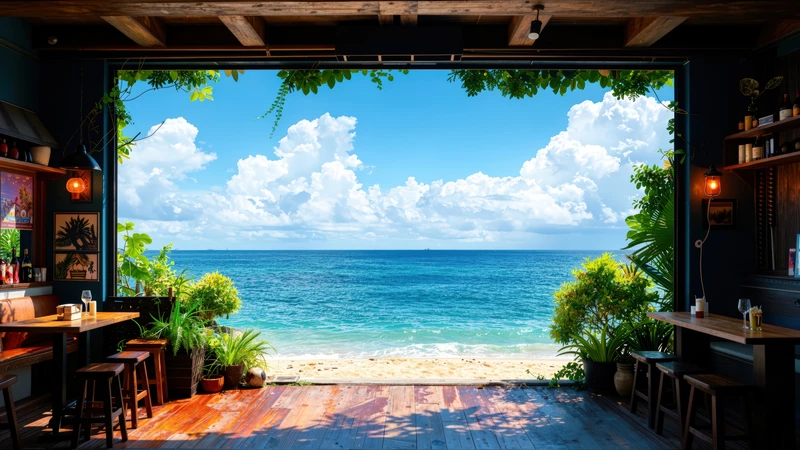
  • Post-work transition (5–7 p.m.): Your screen shouldn’t scream “still working!” Warm-toned scenes — think cozy seaside cafés at golden hour, lantern-lit village lanes, or quiet harbor docks — act as psychological bookends. They signal closure. The gentle glow mimics sunset light, cueing your circadian system that work is done. No need to shut down your laptop — just let the wallpaper whisper, “You can step away now.”

This isn’t about aesthetics. It’s about intentional environmental design. Your desktop is the most frequently viewed surface in your life — more than your walls, your desk, even your coffee mug. Treating it as a passive backdrop wastes a powerful opportunity for micro-restoration.

The Anime Landscape 4K Desktop Wallpaper Pack was designed precisely for this rhythm. Its 17 scenes — Japanese rice fields, lakeside cafés, alpine meadows, mountain villages, tropical beaches, and fantasy valleys — avoid visual noise while honoring emotional nuance. Each image uses soft-focus rendering and carefully tuned palettes (no jarring contrasts, no forced drama) so your nervous system can settle — not scan. They’re not escapes. They’re anchors.

And you don’t need to overhaul your entire setup. Start with one swap. Pick the scene that makes your shoulders drop the moment you see it. Set it. Breathe. Blink. Notice the difference — not in minutes, but in seconds.

Because here’s the quiet truth: your screen doesn’t have to be a stress trigger. With the right visual language, it can become your most accessible, always-on tool for calm — no app, no subscription, no extra screen time required. Just one intentional choice, made once, that quietly reshapes how your nervous system moves through the day.