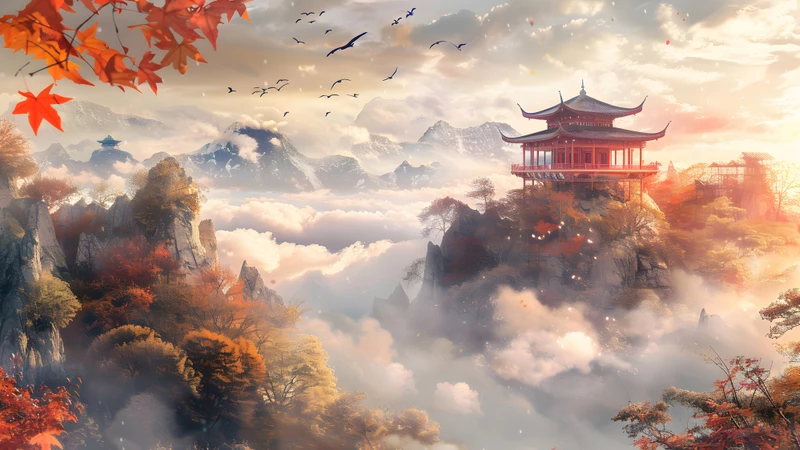
Maple Rhythm, Mountain Breath: How Chinese Ink-Wash Wallpapers Quiet the Noise — So Your Ideas Can Rise Like Mist Over Peaks
Stuck in a creative rut? It’s not your process—it’s your pixels. Learn how intentional wallpaper choices—especially serene, layered scenes like those in the [Chinese Style Maple Leaves and Mountain Landscape 8K Ultra HD Wallpaper Pack](/packs/chinese-style-maple-leaves-mountain-landscape-8k-caa949fd)—can subtly shift your mental state, sharpen visual thinking, and invite ideas without demand.
You’ve opened Figma for the third time today—and still haven’t sketched anything. Not because you’re blocked, but because your screen feels like a crowded subway platform: too much visual noise, no room to think.
It’s not your discipline. It’s not your process. It’s the wallpaper behind your tools—the silent background actor in every creative decision you make. Most people choose wallpapers for beauty alone: a sunset, a sleek gradient, a favorite band logo. But beauty without intention is like lighting a candle in a hurricane—it flickers, then fades. Real creative fuel doesn’t shout. It settles. It breathes. And it waits—not for attention, but for resonance.
That’s why designers, writers, and developers who consistently generate fresh ideas rarely settle for ‘pretty’ pixels. They curate cognitive space. And one of the most quietly powerful tools for that is Eastern-inspired composition—especially ink-wash landscapes layered with maple leaves, misted peaks, and plum blossoms. Think of it like choosing the acoustics of your studio before picking up an instrument.
Why ‘Pretty’ Wallpapers Rarely Spark Real Creativity
Here’s what most people get wrong: creativity isn’t ignited by stimulation—it’s unlocked by reduction. Not emptiness, but intentional subtraction. A glossy photo of Tokyo at night may dazzle—but its high contrast, saturated neon, and chaotic geometry force your visual cortex into constant micro-decisions: Is that sign legible? What building is that? Why is that light so bright? Each tiny judgment burns cognitive bandwidth—bandwidth you need for metaphor-making, pattern-matching, and lateral leaps.
Think of it like trying to hear a whisper while standing next to a jackhammer. The problem isn’t volume—it’s signal-to-noise ratio. ‘Pretty’ wallpapers often have low signal (no clear visual rhythm or resting point) and high noise (busy textures, competing focal points, jarring color shifts). That drains divergent thinking—the kind that lets you connect cherry blossoms to interface transitions, or mountain layers to information architecture.
Minimalism isn’t always the answer either. A flat gray screen may reduce noise, but it offers zero visual scaffolding—no implied depth, no gentle rhythm, no narrative nudge. Your brain doesn’t relax; it idles. You need just enough visual language to feel grounded—so your mind can wander freely from something, not into nothing.
That’s where Eastern aesthetics shine—not as decoration, but as design partners. They don’t compete with your work; they hold space for it.
What Designers Actually Need From a Wallpaper (Hint: It’s Not Just ‘Calm’)
Calm is a side effect—not the goal. What designers truly need from a wallpaper is threefold: visual breathing room, subtle narrative hooks, and chromatic harmony with their UI.
- Visual breathing room: This isn’t about blank space—it’s about intentional pacing. Like pauses between musical phrases, or margins in a well-set paragraph. A mist-shrouded mountain range receding into soft grays gives your eyes a natural path to rest—not because it’s empty, but because it’s layered and gradual. Your gaze moves slowly, not urgently.
- Subtle narrative hooks: These are quiet invitations to imagine—not instructions to interpret. A single maple leaf drifting across a pale sky doesn’t tell a story. It suggests one: seasonality, transience, gentle motion. Your brain fills in the rest—linking that falling leaf to user onboarding flows, or to the idea of graceful exits in interaction design.
- Chromatic harmony with your UI: If your design tools use cool blues and crisp whites, a wallpaper with warm amber tones will create subtle visual friction—like wearing slightly mismatched socks all day. You won’t notice it consciously, but your focus will fatigue faster. Eastern ink-wash palettes—soft greys, muted indigos, warm beiges, and translucent washes of celadon or plum—blend seamlessly with modern interfaces. They don’t clash; they complement, like a neutral backdrop in a gallery that lets the artwork speak.
Contrast matters—but not the kind that screams. Think of it like typography: high-contrast fonts (bold sans-serifs) demand attention; low-contrast ink-brush strokes invite contemplation. Rhythm matters too: repeating forms—like layered mountain ridges or falling petals—create visual cadence, which your brain latches onto like a metronome for thought. And implied depth? That’s your brain’s quiet cue: there’s more here than meets the eye—explore gently.
The Quiet Power of Eastern Composition: How Maple, Mist, and Mountains Train Your Eye
Eastern composition doesn’t fill the frame—it invites into it. At its heart is liú bái: the intentional use of empty or unpainted space—not as absence, but as active presence. In a Chinese ink painting, mist isn’t just atmosphere; it’s a pause button for perception. It says: here is where the eye rests, where the mind catches up. That emptiness isn’t void—it’s fertile ground.
Think of it like silence in a conversation. A well-placed pause doesn’t mean the speaker is done—it means they’re making room for you to respond, reflect, or reframe. Liú bái works the same way on your desktop. When your wallpaper features mist dissolving into distance—or a single branch against a soft sky—your brain isn’t straining to resolve ambiguity. It’s leaning in, making connections, noticing relationships. That’s where associative thinking lives.
Seasonal motifs deepen this effect. A maple leaf isn’t just red—it’s autumn, which carries associations of transition, release, and layered change. Plum blossoms appear in late winter—fragile, persistent, hopeful—evoking resilience and quiet beginnings. Cherry petals drift downward, not in chaos, but in slow, overlapping arcs—mirroring how ideas often surface: not as lightning bolts, but as gentle accumulations.
It’s similar to how scent triggers memory: these motifs aren’t literal symbols—they’re emotional anchors. Your brain links them to feelings of patience, impermanence, balance. And those feelings subtly shape your creative posture. You’re less likely to force a solution when your background whispers let it unfold.
This isn’t passive decoration. It’s visual training. Over time, your eye learns to read subtlety—to find rhythm in repetition, depth in gradation, meaning in restraint. That trained sensitivity transfers directly to your work: you’ll spot hierarchy faster in layouts, sense imbalance in color systems, and intuit flow in interactions—because your peripheral vision has been practicing it all along.
Practical Pairing: Matching Wallpaper Energy to Your Creative Phase
Not every creative moment needs the same visual energy. Your wallpaper should shift with your intent—not stay static like default wallpaper.
When you’re in ideation mode, reach for mist-shrouded peaks or wide, hazy horizons. These scenes offer expansive negative space and soft transitions—ideal for open-ended thinking. The lack of hard edges invites ambiguity, helping you hold multiple possibilities at once. At 8K resolution, the subtle grain of ink texture adds tactile warmth without visual clutter—supporting sustained attention without fatigue.
When you move into refinement mode, switch to crisper compositions: a classical courtyard with clean stone lines, or a single plum branch against a pale sky. These offer gentle structure—not rigidity—guiding precision without stifling nuance. The clarity supports editing decisions: alignment, spacing, contrast. Here, 4K resolution often strikes the perfect balance: sharp enough to read detail, soft enough to avoid glare.
And when you need emotional reset or narrative spark, try floating cherry petals or maple leaves caught mid-drift. These aren’t backgrounds—they’re micro-stories. Their motion implies time, sequence, cause-and-effect. They’re especially powerful before writing briefs, crafting user journeys, or designing micro-interactions. The gentle fall echoes the rhythm of scrolling, loading, or transitioning states.
Resolution matters more than you think. 8K isn’t about ‘more pixels’—it’s about textural fidelity. In ink-wash scenes, 8K reveals the faintest brushstroke variation, the softest edge fade, the delicate transparency of layered mist. That fidelity creates subconscious trust in the image—your brain registers it as crafted, not generic. And when your environment feels intentionally made, you’re more likely to approach your own work with care.
The Chinese Style Maple Leaves and Mountain Landscape 8K Ultra HD Wallpaper Pack was built with exactly this rhythm in mind: 14 desktop-wide scenes for deep focus, 6 mobile-portrait versions for on-the-go reflection, and every image tuned to support—not distract from—the creative act. You’ll find ‘Maple Rhythm of the East’, where falling leaves trace gentle diagonals across soft parchment tones—and ‘Plum Shadows in Mountain Abode’, where ink gradients dissolve into quiet emptiness, inviting you to project your next idea into the mist.
Stuck in a creative rut? It’s not your process—it’s your pixels. Learn how intentional wallpaper choices—especially serene, layered scenes like those in the Chinese Style Maple Leaves and Mountain Landscape 8K Ultra HD Wallpaper Pack—can subtly shift your mental state, sharpen visual thinking, and invite ideas without demand.
If you're curious how other visual languages support different creative moods—from kinetic line art to biophilic gradients—browse wallpapers by intention, not just aesthetics. Because your screen isn’t just where you work. It’s where your next idea begins to gather—like mist over a quiet peak.
Related Articles
Your Screen Is a Stress Trigger — Here’s How Anime Landscape Wallpapers Quiet Your Nervous System in Under 60 Seconds
Staring at your screen all day? Discover how carefully chosen nature wallpapers ...
Three Clicks to Calm: How to Choose a Wind-Down Wallpaper That Feels Like Stepping Into a Miyazaki Landscape
You close your laptop after back-to-back Zoom calls—and your screen still feels ...
Maple Leaves, Roses & Your Morning Slump: How to Match Your Oriental Wallpaper to Your Energy Level — In Just 4 Steps
Feeling drained by 10 a.m.? Your wallpaper might be working against you. This st...