How a Wallpaper Quietly Boosts Remote Work Focus
Explores how wallpaper affects focus and cognitive load for remote workers, grounded in environmental psychology—plus science-backed image selection principles and practical tips.
As remote work becomes the norm, we spend more time in front of screens—but not necessarily more time focused on actual work. Have you ever opened your laptop, glanced at your desktop, and instantly lost focus to cluttered icons, harsh colors, or meaningless images? Psychology research confirms that our visual environment isn’t just background noise—it’s an ‘invisible interface’ shaping how we allocate cognitive resources. Color, composition, and imagery in your workspace continuously signal your brain, regulating alertness, emotional state, and attention stamina. This is the core insight of Workplace Environmental Psychology: environment isn’t a container—it’s a collaborator.
The impact of visual stimuli on concentration has a physiological basis. Neuroscience shows the human visual cortex processes images far faster than language—roughly 13 milliseconds for initial recognition. That means the moment you power up your computer, your wallpaper has already activated both your amygdala (emotion center) and prefrontal cortex (executive control center). High-saturation red-yellow palettes trigger sympathetic nervous system arousal—ideal for short bursts but disruptive for deep thinking. In contrast, low-contrast, neutral tones, and natural organic forms—like mountain silhouettes or water ripples—reduce visual cortex load and promote alpha brainwave activity, strongly associated with flow states. A controlled study published in the Journal of Environmental Psychology found remote workers using nature-themed wallpapers experienced a 27% average increase in sustained focus and a 34% self-reported reduction in cognitive fatigue.
So what makes a wallpaper truly suited for remote work? First, it must follow the ‘cognitive whitespace’ principle: avoid information overload. Text-heavy layouts, intricate patterns, or animated GIFs force constant visual decoding—draining attention bandwidth better spent on tasks. Second, it should provide ‘semantic anchoring’: conveying stability, control, and predictability. For example, expansive远景 scenes ease spatial confinement (especially valuable for small-home offices), while soft vertical lines—like bamboo groves or waterfalls—guide the eyes downward naturally, reducing unconscious screen wandering. Cultural symbols also shape meaning: the ‘negative space’ and ‘qi-yun’ (vital rhythm) in traditional East Asian ink-wash landscapes are, in essence, a millennia-tested visual stress-reduction system—not offering answers, but creating breathing room for thought.
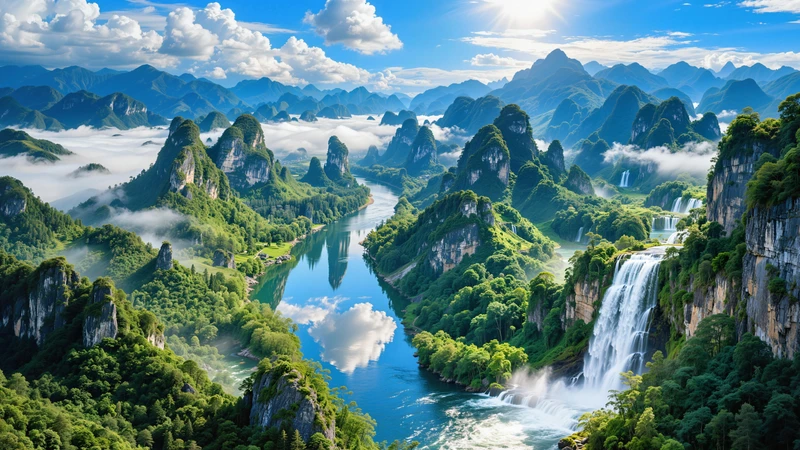
We recommend WallpaperSense’s curated ‘Ink-Wash Landscape 8K Desktop Wallpaper Pack’: 16 ultra-high-resolution ink-wash landscape wallpapers featuring classic motifs—bamboo forests, mountain streams, lakeside views, cascading waterfalls, and cherry-blossom valleys. Each image is rendered in native 8K resolution for wide-screen desktops, preserving authentic shanshui意境 while using subtle grayscale gradations and restrained composition to achieve a true ‘visual silence’. Users consistently report reduced pre-meeting anxiety and fewer writing blocks after switching—this isn’t mysticism, but gentle environmental calibration of mental rhythm.
Of course, wallpaper is only the starting point. Sustainable focus requires multidimensional alignment: treat your wallpaper as a ‘visual anchor’, pair it with circadian-aligned screen brightness (e.g., automatic color temperature adjustment), keep your physical desk minimal (only today’s essential items), and practice a ‘gaze reset’ every 90 minutes—looking at greenery beyond 5 meters outdoors. These small design choices collectively form a supportive environmental system. As environmental psychologist James J. Gibson observed: ‘We don’t perceive isolated objects—we perceive affordances: action invitations offered by the environment.’ A great wallpaper invites deep focus; a poor one constantly whispers, ‘This isn’t where work happens.’
Finally, beware the ‘productivity tool trap’: don’t fall into endless tweaking of wallpapers, fonts, or themes. Once you choose a wallpaper aligned with your current mental needs, commit to it for at least two weeks—letting your visual system settle into stable expectation. That’s the real wisdom of environmental design. Your desktop shouldn’t be an optimization variable—it should be a reliable gateway into flow.
Related Articles
From Distracted to Focused in One Wallpaper Swap: How Minimalist Flower Fields Transformed My Study Screen (and Why Yours Might Too)
Staring at a cluttered desktop while trying to study? We compare real student se...
Why Your Meditation App Needs a Miyazaki Night Scene Behind It — The Quiet Rise of Mindful Wallpaper Design
More people are choosing intentional wallpapers not just to decorate screens—but...
Three Minutes to Calm: How to Choose a Lunch-Break Wallpaper That Feels Like Stepping Into a Chinese Autumn Orchard
You’ve got 20 minutes. Your eyes are tired. Your brain feels like static. Here’s...